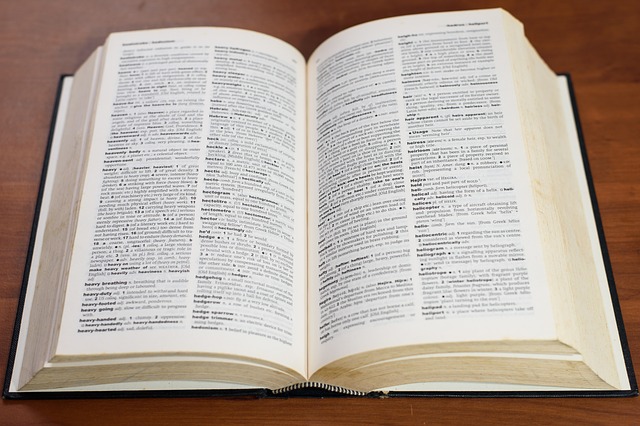
Merriam-Webster Dictionary added more than 1,000 words and phrases to the dictionary in 2017. And while we can’t highlight every single one here, we can highlight the most interesting words and phrases as well as those that received the most attention. According to Merriam-Webster:
GrammarPhile Blog
New Words Added to the Dictionary in 2017
Posted by Phil Jamieson Apr 27, 2018, 7:30:00 AM
How Words Are Added to a Dictionary
Posted by Conni Eversull Sep 14, 2017, 7:30:00 AM
Without hesitation, most people trust their dictionary as the true authority on language. When there’s a debate about the validity of a word or phrase, or you want to know how it’s spelled, you look it up in the dictionary without questioning it.
Essentially all words are made up in one way or another, but how do they get added to the dictionary? Is there someone who gets the final say in determining whether a word can and should be included in the dictionary? And is there a set process for adding words to the dictionary? The answer to both latter questions is: yes.
Topics: dictionary, words, how are words added to the dictionary
Merriam Webster and OED Are Off the Chain!
Posted by Julie DeSilva Jan 31, 2012, 5:30:00 AM
In 2011 Merriam-Webster added more than 150 new words to the dictionary, including social media and bromance. And the Oxford English Dictionary added such phrases as light-bulb moment and environmentally unfriendly.
Topics: vocabulary, dictionary, trends in language
Search Our Blog
Recent Posts
Posts by Topic
- business writing (33)
- proofreading (24)
- punctuation (22)
- grammar (19)
- misused words (16)
- vocabulary test (16)
- quiz (15)
- writing tips (13)
- capitalization (12)
- vocabulary quiz (12)
- hyphenation (10)
- word quiz (10)
- common mistakes (9)
- pronouns (9)
- conjunctions (8)
- grammar errors (8)
- legal writing (8)
- word test (8)
- adjectives (7)
- effective writing (7)
- grammar quiz (7)
- possessives (7)
- prepositions (7)
- typos, typographic errors (7)
- verbs (7)
- writing (7)
- Chicago Manual of Style (6)
- Popular Style Guides (6)
- Style Guides (6)
- artificial intelligence (6)
- hyphen (6)
- marketing writing (6)
- quiz answers (6)
- vocabulary (6)
- Comma (5)
- Oxford comma (5)
- adverbs (5)
- business communications (5)
- email marketing (5)
- idioms (5)
- numbers (5)
- passive voice (5)
- AI (4)
- abbreviations (4)
- clarity proofreading (4)
- commas (4)
- consistency in writing (4)
- editing (4)
- errors (4)
- homonyms (4)
- preposition (4)
- proofreaders (4)
- proofreading tips (4)
- proofreadinq quiz (4)
- quotation marks (4)
- website copy (4)
- word usage (4)
- writing style (4)
- writing techniques (4)
- active voice (3)
- apostrophe (3)
- cliches (3)
- common proofreading mistakes (3)
- contest (3)
- creative writing (3)
- dictionary (3)
- email (3)
- grammar rules (3)
- grammatical errors (3)
- infinitives (3)
- medical writing (3)
- periods (3)
- plural (3)
- plural or singular verb (3)
- professional proofreading (3)
- proofreader (3)
- proofreading for legal documents (3)
- proofreading quality (3)
- proofreading quiz (3)
- proofreading websites (3)
- slang (3)
- spacing (3)
- spelling (3)
- style copyediting (3)
- style guide (3)
- technical writing (3)
- trends in language (3)
- typographical errors (3)
- typos (3)
- what to expect from proofreaders (3)
- who (3)
- word meaning (3)
- writing about boring topics (3)
- writing mistakes (3)
- 10 helpful tips (2)
- AP style (2)
- English language (2)
- Latin abbreviations (2)
- Modern Language Association Style Manual (2)
- Nouns (2)
- Oxford Style Manual (2)
- The Elements of Style (2)
- alot/a lot (2)
- apostrophes (2)
- automated grammar checker (2)
- b2b marketing content (2)
- b2b writing help (2)
- business proofreading (2)
- clauses (2)
- collective noun (2)
- copyright (2)
- correct pronunciation (2)
- correcting grammar (2)
- dangling modifiers (2)
- em dash (2)
- financial writing (2)
- formal writing (2)
- gerunds (2)
- grammar checker (2)
- grammar checker software (2)
- grammar mistakes (2)
- grammar tips (2)
- how are words added to the dictionary (2)
- how to write out money in text (2)
- informal writing (2)
- italicize (2)
- jargon (2)
- lay (2)
- laying (2)
- legal proofreading (2)
- lie (2)
- maintain consistency in writing (2)
- malapropism (2)
- misspelled words (2)
- misspellings (2)
- nonrestrictive clauses (2)
- parallel structure (2)
- parallelism (2)
- parts of speech (2)
- percent (2)
- percent sign (2)
- percentage (2)
- percentage points (2)
- persuade (2)
- plurals (2)
- possessive form (2)
- possessives of proper nouns (2)
- prefixes (2)
- pronunciation (2)
- proofreading for business (2)
- proofreading quiz answers (2)
- proofreading tricks (2)
- proposals (2)
- public relations writing (2)
- punctuation quiz (2)
- question mark (2)
- redundancy (2)
- restrictive clauses (2)
- sentence structure (2)
- subjunctive form (2)
- suffixes (2)
- synonyms (2)
- their (2)
- there (2)
- they're (2)
- typographic errors (2)
- using jargon (2)
- what to expect from a proofreader (2)
- whom (2)
- writers (2)
- writing for your audience (2)
- writing guidelines (2)
- writing quiz (2)
- writing voice (2)
- #writersblock (1)
- AM (1)
- AP stylebook (1)
- Associated Press Stylebook (1)
- B2B Writing (1)
- Find and replace (1)
- Greek word roots (1)
- Gregg Reference Manual (1)
- I or me (1)
- Latin word roots (1)
- Midnight (1)
- Noon (1)
- O or oh (1)
- PM (1)
- Video (1)
- academic terms (1)
- affixes (1)
- ahold/a hold (1)
- alright/all right (1)
- antonym (1)
- appositives (1)
- articles (1)
- avoiding gender bias (1)
- awhile/a while (1)
- beat writer's block (1)
- beside or besides? (1)
- bias (1)
- bizspeak (1)
- bloated writing (1)
- blog (1)
- blog posts (1)
- business phrases to stop using (1)
- buzzwords (1)
- casual writing (1)
- comparatives (1)
- comparison of proofreading services (1)
- complementary infinitives (1)
- compound modifiers (1)
- compound nouns (1)
- compound sentences (1)
- compound verbs (1)
- compound words (1)
- conditional clauses (1)
- confusing words (1)
- conjugating verbs (1)
- consistency in proofreading (1)
- consistent messaging (1)
- content (1)
- continuously and continually (1)
- convince (1)
- copyediting (1)
- copyeditor (1)
- cursive writing (1)
- dash (1)
- dates (1)
- documents (1)
- double negative (1)
- double negatives (1)
- dumbing down of language (1)
- e.g. (1)
- each other and one another (1)
- editorial occupations (1)
- eggcorns (1)
- emoji (1)
- emojis (1)
- en dash (1)
- essential clauses (1)
- exclamation point (1)
- exempli gratia (1)
- false subject (1)
- fighting writer's block (1)
- figures (1)
- first-person pronouns (1)
- footnotes (1)
- foreign phrases (1)
- foreign words (1)
- gender bias (1)
- government writing (1)
- government-related words (1)
- grammar fails (1)
- headline errors (1)
- holidays (1)
- homographs (1)
- homophone (1)
- hypallage (1)
- hyperbole (1)
- i.e., (1)
- id est (1)
- if and whether (1)
- imperative mood (1)
- imply (1)
- in behalf of and on behalf of (1)
- independent clauses (1)
- indicative mood (1)
- infer (1)
- interrogative pronouns (1)
- into versus in to (1)
- irregardless (1)
- irregular verbs (1)
- laid (1)
- lain (1)
- liable and likely (1)
- like (1)
- links (1)
- literally (1)
- literary devices (1)
- lying (1)
- main clauses (1)
- marketing email (1)
- misplaced modifiers (1)
- missing dates (1)
- mistakes (1)
- modifiers (1)
- multiple subjects (1)
- myth (1)
- negatives (1)
- noun clauses (1)
- objective pronouns (1)
- onomatopoeia (1)
- onto versus on to (1)
- or that (1)
- paragraph (1)
- paragraph construction (1)
- participle (1)
- participles (1)
- past participle (1)
- past tense (1)
- personal profile (1)
- placement of only (1)
- plural pronouns (1)
- pluralize (1)
- points (1)
- preposition at end of sentence (1)
- prepositional phrases (1)
- present participle (1)
- present perfect tense (1)
- presently (1)
- press release length (1)
- press releases (1)
- professional proofreader (1)
- project management (1)
- pronouncing words beginning with h (1)
- pronouns with than (1)
- proofeading technique (1)
- proofread (1)
- proofreader myths (1)
- proofreading errors (1)
- proofreading mistakes (1)
- proofreading red flags (1)
- published documents (1)
- quotations (1)
- readability (1)
- redundant phrases (1)
- reflexive pronouns (1)
- regular verbs (1)
- relative clauses (1)
- relative pronouns (1)
- religious words (1)
- repeating words (1)
- resume (1)
- resume writing (1)
- rules for writing (1)
- run-on sentences (1)
- scientific terms (1)
- scientific writing (1)
- search engines (1)
- semicolon (1)
- sentence fragments (1)
- sentence restructure (1)
- sentences (1)
- seo (1)
- sic (1)
- singular (1)
- singular pronouns (1)
- singular they (1)
- singular verb (1)
- skills needed for proofreading (1)
- skills-based resume (1)
- slash (1)
- social media (1)
- space issues (1)
- spaces (1)
- spell check (1)
- spell-check software (1)
- split infinitive (1)
- squinting modifiers (1)
- starting sentences with and (1)
- style sheet (1)
- subjective pronouns (1)
- subjunctive mood (1)
- superscript (1)
- supposably (1)
- survey (1)
- technical editing (1)
- templats (1)
- thank you notes (1)
- that (1)
- that vs. which (1)
- this versus that (1)
- time (1)
- time of day (1)
- time-related modifiers (1)
- toward or towards (1)
- two letter word (1)
- use of because (1)
- using I or me (1)
- using spaces in abbreviations (1)
- verbosity (1)
- video content (1)
- what proofreaders don't do (1)
- what proofreaders want you to know (1)
- what to expect from a copyeditor (1)
- what to expect from an editor (1)
- when to omit that (1)
- when to use that (1)
- whereas (1)
- which (1)
- who and whoever (1)
- whom and whomever (1)
- word choices (1)
- word roots (1)
- words (1)
- words to avoid (1)
- writing bios (1)
- writing currency (1)
- writing marketing copy (1)
- writing myth (1)
- writing number in dialogue (1)
- writing numbers (1)
- writing portfolio (1)
- writing press releases (1)
- writing rituals (1)
- writing skills (1)
- writing thank you notes (1)
- writing topics (1)
- writing web copy (1)
- you or yourself (1)