Well, sometimes your game's just not there, and so it seems you're randomly tossing the ball hither and yon with no target in sight. But don't cry if you flunk this test! Take your best shot, and if you don't get them all, there's always next week/month/year/life.
GrammarPhile Blog
Phil Jamieson
Recent Posts
Subjects Joined by "And"
Posted by Phil Jamieson Feb 8, 2011, 5:30:00 AM
We see confusion reign when it comes to multiple subjects in sentences. Let's refer to some cogent advice from The Gregg Reference Manual:
If the subject consists of two or more words that are connected by and or by both...and, the subject is plural and requires a plural verb.
Topics: singular verb, multiple subjects, plural or singular verb
Can Nine Women Do Something Miraculous in One Month?
Posted by Phil Jamieson Jan 11, 2011, 5:30:00 AM
We, like many people I know who frequent sites like Amazon, ESPN, and even my newest favorite, BackyardChickens.com, have recently been overrun with banner ads for a new 'proofreading' service. It seems a group of Internet enthusiasts convinced some California venture capitalists to come up with $5 million and started what they hope is a competitor to ProofreadNOW.com. Replete with content-free buzzwords ("the 'secret sauce' is in how we process documents"), this service offers cheap proofreading in a blistering 24 hours.
Topics: comparison of proofreading services, consistency in proofreading, proofreading quality
Give Us Examples of Bad Grammar or Writing in Publications
Posted by Phil Jamieson Dec 7, 2010, 5:30:00 AM
Thanks for reading our GrammarPhile blog.
Topics: misspelled words, misspellings, misused words, word usage
Wrong Words Make Bad First Impression
Posted by Phil Jamieson Oct 26, 2010, 10:41:00 AM
Making sales today is tough business. Finding jobs is even tougher. And though everybody is allowed a mistake here and there, the gatekeepers to both sales and jobs are clamping down on proposals and resumes, and even speech patterns. They're saying to themselves more and more, "Make the first pass easier by simply eliminating the ones with mistakes." So you want to avoid mistakes! Here are some more tips on making the right choice in words:
Topics: errors, misused words, proposals
Word Test - Phobias
Posted by Phil Jamieson Oct 19, 2010, 4:30:00 AM
While phobias can be serious challenges for affected people and their psychiatrists, most of us toss the extension onto almost any word and run with it. Schoolophobia is what you have at the end of vacation. Dogophobia is what you have if you've been bitten by a dog. Is phobophobia what you have when you fear being labeled as fearful? Here are some real phobias. Can you identify the meanings?
Often-Confused Words
Posted by Phil Jamieson Oct 5, 2010, 4:30:00 AM
Well, the words aren't confused, but sometimes people who use them are. Our job today is to help you avoid confusing the following words, some of which we've seen even in documents processed by our editors THIS VERY DAY!
Topics: misused words
Word Test - Oil. It's on the Brain These Days.
Posted by Phil Jamieson Sep 7, 2010, 5:00:00 AM
The price of oil. The countries that have it. The companies that produce it. The people who buy it. Talk is everywhere. Try this slick vocab quiz and see how much your brain is worth per barrel. 1. hydrocarbon: (a) a residual product (as from the distillation of petroleum); (b) a chemical isolated or derived from petroleum or natural gas; (c) an organic compound (as acetylene or butane) containing only carbon and hydrogen and often occurring in petroleum, natural gas, coal, and bitumens; (d) carbon derived from seawater.
2. oil cake: (a) the solid residue after extracting the oil from seeds (as of cotton); (b) a cake whose ingredients include canola oil, peanut oil, molasses and ginger; (c) an oil (as linseed oil) that changes readily to a hard tough elastic substance when exposed in a thin film to air; (d) dipstick.
3. crack: (a) to disperse (as an oil) in an emulsion; (b) to break up (chemical compounds) into simpler compounds by means of heat; (c) an oil well with a copious natural flow; (d) a constriction in an outlet (as of an oil well) that restricts flow.
4. copra: (a) dried coconut meat yielding coconut oil; (b) a yellow fatty oil obtained from the germ of Indian corn kernels and used chiefly as salad oil, in soft soap, and in margarine; (c) a usually glass bottle used to hold a condiment (as oil or vinegar) for use at the table; (d) a fragrant essential oil (as from rose petals).
5. baba ghanoush: (a) thick slices of bread grilled, rubbed with garlic, drizzled with olive oil, often topped with tomatoes and herbs, and usually served as an appetizer; (b) bituminous material occurring in shale and yielding oil when heated; (c) an appetizer or spread made chiefly of eggplant, tahini, garlic, olive oil, and lemon; (d) (capped) the prime minister of oil-rich Oman.
6. holy oil: (a) petroleum oil produced in the Holy Land; (b) petroleum oil high in myrrh; (c) mineral spirits; (d) olive oil blessed by a bishop for use in a sacrament or sacramental.
7. sweet crude: (a) crude oil light in sulfur content; (b) crude oil light in hydrocarbon content; (c) crude oil light in sodium content; (d) crude oil heavy in sucrose content.
8. Brent crude: (a) crude oil produced in Brent County, Texas; (b) crude oil produced in a part of the North Sea; (c) petroleum oil traded for Krugerands in South Africa; (d) crude oil drilled by a guy named Brent.
9. cresset: (a) a usually glass bottle used to hold a condiment (as oil or vinegar) for use at the table; (b) consecrated oil used in Greek and Latin churches especially in baptism, chrismation, confirmation, and ordination; (c) a framework or tower over a deep drill hole (as of an oil well) for supporting boring tackle or for hoisting and lowering; (d) an iron vessel or basket used for holding an illuminant (as oil) and mounted as a torch or suspended as a lantern.
10. derrick: (a) a graduated rod for indicating depth (as of oil in a crankcase); (b) a framework or tower over a deep drill hole (as of an oil well) for supporting boring tackle or for hoisting and lowering; (c) a building and equipment for refining or processing (as oil or sugar); (d) the head domino.
Topics: word test, vocabulary
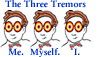
Me, Myself, and I
Posted by Phil Jamieson Aug 31, 2010, 4:30:00 AM
IS IT I or IS IT ME: Linking up.
Guideline. Favor the subjective case form for pronouns that follow linking verbs, but don't force the issue in conversation.
- It was they who initiated the idea of holding the water ski tournament in Alberta next year. (They is in the subjective case because it follows the linking verb was.)
- It is we who must take the responsibility for the injuries we suffered when we jumped off Frye's Leap. (We is in the subjective case because it follows the linking verb is.)
But: - If anyone can vouch for Talullah's dependability, it's me. (I is technically correct, but me is the natural choice in conversation and is considered acceptable in all but the most formal writing situations.)
MYSELF or ME. Beware of self-indulgence.
Guideline. Confine your use of pronouns ending in -self to those situations in which the -self forms are appropriate. Don't fall victim to the misguided assumption that "myself" is a more elegant way of saying "I" or "me."
- Sassafras and I would love to judge this year's slam-dunk contest. (There is no need for myself; I is the proper choice.)
- We would like to invite Mortimer and you to travel with us next spring to Two Egg. (There is no need for yourself; you is the proper choice.)
- Q: How are you? A: Fine, and you? (NEVER answer "Fine, and yourself?" It is less than substandard English. It is like answering, "Fine, and how is yourself?" And that sounds flakey.)
A closer look. There are two legitimate uses of pronouns that end in -self. One is for emphasis. The other is with reflexive verbs.
-
Emphasis
- I myself will be driving the towboat for the slalom competition. (Following I with myself emphasizes that the speaker intends to take full responsibility for the driving.)
- Matilda herself will write the acceptance speech. (No speechwriters need apply for the job.)
Reflexive Verbs - The children amused themselves by barefoot skiing and by skiing backwards. (Themselves is the object of amused [a reflexive verb] and refers back to children.)
- Lucius has a habit of causing injury to himself whenever he starts skiing from the beach. (Himself is the object of the preposition to, and refers back to Lucius.)
- I nearly killed myself when I hit the wake at 75 mph. (Myself is the object of the verb killed and refers back to I.)
Possible exception: - As for myself, the plans for the airplane trip are still up in the air. (Me is probably the better choice, but myself could be defended on the grounds that the writer or speaker wants to emphasize the first-person pronoun and has elected to omit me.)
Partial source: Grammar for Smart People by Barry Tarshis.
Headline Style -- Read All About It!
Posted by Phil Jamieson Aug 24, 2010, 4:30:00 AM
If you're in the newspaper business, you know how to properly capitalize headlines. But people writing white papers, press releases, brochures, and even résumés need to know what's right and what's wrong in order to retain the respect and admiration, to say nothing of the trust, of their readers. So take note!
Most style guides call for lower-casing prepositions, articles, and many conjunctions. But there are lots of extenuating circumstances that call for uppercasing those words sometimes. Read on, but first:
- A preposition is a word that could describe your relationship to a cloud: you're in the cloud, under the cloud, above the cloud, around the cloud, by the cloud, before the cloud, after the cloud. These italicized words are prepositions.
- The articles are the, a, and an -- they point out things: the boy, a man.
- Conjunctions join things: and, or, nor, while, etc.
The Chicago Manual of Style says to always capitalize the first and last words of a headline, no matter what. Lowercase prepositions, regardless of length, except when they are stressed (as through in A River Runs Through It), are used adverbially or adjectivally (as up in Look Up, down in Turn Down, on in The On Button, etc.), are used as conjunctions (such as before in Look Before You Leap), or are part of a Latin expression used adjectivally or adverbially (e.g., De Facto, In Vitro, etc.). CMS specifies lowercasing the conjunctions and, but, for, or, nor. Always lowercase to and as.
Examples:
Topics: capitalization, conjunctions, preposition, style guide, Chicago Manual of Style, Gregg Reference Manual
Search Our Blog
Recent Posts
Posts by Topic
- business writing (33)
- proofreading (24)
- punctuation (22)
- grammar (19)
- misused words (16)
- vocabulary test (16)
- quiz (15)
- writing tips (13)
- capitalization (12)
- vocabulary quiz (12)
- hyphenation (10)
- word quiz (10)
- common mistakes (9)
- pronouns (9)
- conjunctions (8)
- grammar errors (8)
- legal writing (8)
- word test (8)
- adjectives (7)
- effective writing (7)
- grammar quiz (7)
- possessives (7)
- prepositions (7)
- typos, typographic errors (7)
- verbs (7)
- writing (7)
- Chicago Manual of Style (6)
- Popular Style Guides (6)
- Style Guides (6)
- artificial intelligence (6)
- hyphen (6)
- marketing writing (6)
- quiz answers (6)
- vocabulary (6)
- Comma (5)
- Oxford comma (5)
- adverbs (5)
- business communications (5)
- email marketing (5)
- idioms (5)
- numbers (5)
- passive voice (5)
- AI (4)
- abbreviations (4)
- clarity proofreading (4)
- commas (4)
- consistency in writing (4)
- editing (4)
- errors (4)
- homonyms (4)
- preposition (4)
- proofreaders (4)
- proofreading tips (4)
- proofreadinq quiz (4)
- quotation marks (4)
- website copy (4)
- word usage (4)
- writing style (4)
- writing techniques (4)
- active voice (3)
- apostrophe (3)
- cliches (3)
- common proofreading mistakes (3)
- contest (3)
- creative writing (3)
- dictionary (3)
- email (3)
- grammar rules (3)
- grammatical errors (3)
- infinitives (3)
- medical writing (3)
- periods (3)
- plural (3)
- plural or singular verb (3)
- professional proofreading (3)
- proofreader (3)
- proofreading for legal documents (3)
- proofreading quality (3)
- proofreading quiz (3)
- proofreading websites (3)
- slang (3)
- spacing (3)
- spelling (3)
- style copyediting (3)
- style guide (3)
- technical writing (3)
- trends in language (3)
- typographical errors (3)
- typos (3)
- what to expect from proofreaders (3)
- who (3)
- word meaning (3)
- writing about boring topics (3)
- writing mistakes (3)
- 10 helpful tips (2)
- AP style (2)
- English language (2)
- Latin abbreviations (2)
- Modern Language Association Style Manual (2)
- Nouns (2)
- Oxford Style Manual (2)
- The Elements of Style (2)
- alot/a lot (2)
- apostrophes (2)
- automated grammar checker (2)
- b2b marketing content (2)
- b2b writing help (2)
- business proofreading (2)
- clauses (2)
- collective noun (2)
- copyright (2)
- correct pronunciation (2)
- correcting grammar (2)
- dangling modifiers (2)
- em dash (2)
- financial writing (2)
- formal writing (2)
- gerunds (2)
- grammar checker (2)
- grammar checker software (2)
- grammar mistakes (2)
- grammar tips (2)
- how are words added to the dictionary (2)
- how to write out money in text (2)
- informal writing (2)
- italicize (2)
- jargon (2)
- lay (2)
- laying (2)
- legal proofreading (2)
- lie (2)
- maintain consistency in writing (2)
- malapropism (2)
- misspelled words (2)
- misspellings (2)
- nonrestrictive clauses (2)
- parallel structure (2)
- parallelism (2)
- parts of speech (2)
- percent (2)
- percent sign (2)
- percentage (2)
- percentage points (2)
- persuade (2)
- plurals (2)
- possessive form (2)
- possessives of proper nouns (2)
- prefixes (2)
- pronunciation (2)
- proofreading for business (2)
- proofreading quiz answers (2)
- proofreading tricks (2)
- proposals (2)
- public relations writing (2)
- punctuation quiz (2)
- question mark (2)
- redundancy (2)
- restrictive clauses (2)
- sentence structure (2)
- subjunctive form (2)
- suffixes (2)
- synonyms (2)
- their (2)
- there (2)
- they're (2)
- typographic errors (2)
- using jargon (2)
- what to expect from a proofreader (2)
- whom (2)
- writers (2)
- writing for your audience (2)
- writing guidelines (2)
- writing quiz (2)
- writing voice (2)
- #writersblock (1)
- AM (1)
- AP stylebook (1)
- Associated Press Stylebook (1)
- B2B Writing (1)
- Find and replace (1)
- Greek word roots (1)
- Gregg Reference Manual (1)
- I or me (1)
- Latin word roots (1)
- Midnight (1)
- Noon (1)
- O or oh (1)
- PM (1)
- Video (1)
- academic terms (1)
- affixes (1)
- ahold/a hold (1)
- alright/all right (1)
- antonym (1)
- appositives (1)
- articles (1)
- avoiding gender bias (1)
- awhile/a while (1)
- beat writer's block (1)
- beside or besides? (1)
- bias (1)
- bizspeak (1)
- bloated writing (1)
- blog (1)
- blog posts (1)
- business phrases to stop using (1)
- buzzwords (1)
- casual writing (1)
- comparatives (1)
- comparison of proofreading services (1)
- complementary infinitives (1)
- compound modifiers (1)
- compound nouns (1)
- compound sentences (1)
- compound verbs (1)
- compound words (1)
- conditional clauses (1)
- confusing words (1)
- conjugating verbs (1)
- consistency in proofreading (1)
- consistent messaging (1)
- content (1)
- continuously and continually (1)
- convince (1)
- copyediting (1)
- copyeditor (1)
- cursive writing (1)
- dash (1)
- dates (1)
- documents (1)
- double negative (1)
- double negatives (1)
- dumbing down of language (1)
- e.g. (1)
- each other and one another (1)
- editorial occupations (1)
- eggcorns (1)
- emoji (1)
- emojis (1)
- en dash (1)
- essential clauses (1)
- exclamation point (1)
- exempli gratia (1)
- false subject (1)
- fighting writer's block (1)
- figures (1)
- first-person pronouns (1)
- footnotes (1)
- foreign phrases (1)
- foreign words (1)
- gender bias (1)
- government writing (1)
- government-related words (1)
- grammar fails (1)
- headline errors (1)
- holidays (1)
- homographs (1)
- homophone (1)
- hypallage (1)
- hyperbole (1)
- i.e., (1)
- id est (1)
- if and whether (1)
- imperative mood (1)
- imply (1)
- in behalf of and on behalf of (1)
- independent clauses (1)
- indicative mood (1)
- infer (1)
- interrogative pronouns (1)
- into versus in to (1)
- irregardless (1)
- irregular verbs (1)
- laid (1)
- lain (1)
- liable and likely (1)
- like (1)
- links (1)
- literally (1)
- literary devices (1)
- lying (1)
- main clauses (1)
- marketing email (1)
- misplaced modifiers (1)
- missing dates (1)
- mistakes (1)
- modifiers (1)
- multiple subjects (1)
- myth (1)
- negatives (1)
- noun clauses (1)
- objective pronouns (1)
- onomatopoeia (1)
- onto versus on to (1)
- or that (1)
- paragraph (1)
- paragraph construction (1)
- participle (1)
- participles (1)
- past participle (1)
- past tense (1)
- personal profile (1)
- placement of only (1)
- plural pronouns (1)
- pluralize (1)
- points (1)
- preposition at end of sentence (1)
- prepositional phrases (1)
- present participle (1)
- present perfect tense (1)
- presently (1)
- press release length (1)
- press releases (1)
- professional proofreader (1)
- project management (1)
- pronouncing words beginning with h (1)
- pronouns with than (1)
- proofeading technique (1)
- proofread (1)
- proofreader myths (1)
- proofreading errors (1)
- proofreading mistakes (1)
- proofreading red flags (1)
- published documents (1)
- quotations (1)
- readability (1)
- redundant phrases (1)
- reflexive pronouns (1)
- regular verbs (1)
- relative clauses (1)
- relative pronouns (1)
- religious words (1)
- repeating words (1)
- resume (1)
- resume writing (1)
- rules for writing (1)
- run-on sentences (1)
- scientific terms (1)
- scientific writing (1)
- search engines (1)
- semicolon (1)
- sentence fragments (1)
- sentence restructure (1)
- sentences (1)
- seo (1)
- sic (1)
- singular (1)
- singular pronouns (1)
- singular they (1)
- singular verb (1)
- skills needed for proofreading (1)
- skills-based resume (1)
- slash (1)
- social media (1)
- space issues (1)
- spaces (1)
- spell check (1)
- spell-check software (1)
- split infinitive (1)
- squinting modifiers (1)
- starting sentences with and (1)
- style sheet (1)
- subjective pronouns (1)
- subjunctive mood (1)
- superscript (1)
- supposably (1)
- survey (1)
- technical editing (1)
- templats (1)
- thank you notes (1)
- that (1)
- that vs. which (1)
- this versus that (1)
- time (1)
- time of day (1)
- time-related modifiers (1)
- toward or towards (1)
- two letter word (1)
- use of because (1)
- using I or me (1)
- using spaces in abbreviations (1)
- verbosity (1)
- video content (1)
- what proofreaders don't do (1)
- what proofreaders want you to know (1)
- what to expect from a copyeditor (1)
- what to expect from an editor (1)
- when to omit that (1)
- when to use that (1)
- whereas (1)
- which (1)
- who and whoever (1)
- whom and whomever (1)
- word choices (1)
- word roots (1)
- words (1)
- words to avoid (1)
- writing bios (1)
- writing currency (1)
- writing marketing copy (1)
- writing myth (1)
- writing number in dialogue (1)
- writing numbers (1)
- writing portfolio (1)
- writing press releases (1)
- writing rituals (1)
- writing skills (1)
- writing thank you notes (1)
- writing topics (1)
- writing web copy (1)
- you or yourself (1)