
A bias is a strong inclination of the mind or a preconceived opinion about something or someone. Most of the time, biases occur on a subconscious level and people aren’t even aware they have them. But everyone still holds biases; it’s simply human nature to be partial toward certain things and not toward others, for a multitude of reasons. A lot of biases can be good, like being partial toward initiatives that help children from low-income families. Some can be neutral, like preferring to read New York Times bestsellers instead of The Wall Street Journal. And some biases are generally considered negative, like racial, age, cultural, and gender biases.
GrammarPhile Blog
Kelly Creighton
Recent Posts
Tips for Avoiding Gender Bias in Your Writing
Posted by Kelly Creighton Oct 12, 2017, 7:30:00 AM
Topics: bias, avoiding gender bias, gender bias
How Good Are You at Conjugating Verbs?
Posted by Kelly Creighton Oct 5, 2017, 7:30:00 AM
Take This Quiz to Find Out
Verb conjugation refers to how a verb changes from one form to another in order to show a different person, tense, number, aspect, or mood. Verbs are critical to understanding what and when something is happening to or via a subject or object in a sentence. It’s vital to know what’s happening in a sentence. And it’s just as important to know who is doing what when we’re communicating, as well as when they’re doing it, and how they’re doing it. Otherwise, we wouldn’t be able to communicate with one another very efficiently.
Topics: verbs, conjugating verbs
How to Write an Impressive Social Media Profile
Posted by Kelly Creighton Sep 28, 2017, 7:30:00 AM
Writing an impressive social media profile isn’t as easy as it seems, especially in an online world where personal and professional lines are becoming more and more blurred. Knowing how to stand out to the right individuals on social media requires a certain amount of finesse. But fortunately, getting your profile noticed isn’t as arbitrary as it seems at first either. If you want to have a notable social media profile that stands out, here are some things you’ll want to do as you’re writing it.
Consider Your Target Audience
Facebook has over two billion users each month. Twitter has over three hundred million users. And LinkedIn has about five hundred million monthly users. With numbers like these, it can seem daunting to try and write a profile that would appeal to so many people. The good news is, you shouldn’t even try to do that. Instead, consider your target audience on each platform and who you want to appeal to the most, and then write information about yourself that is relevant to them.
Topics: social media, personal profile
Advanced Punctuation Quiz
Posted by Kelly Creighton Sep 7, 2017, 7:30:00 AM
Punctuation is used in writing to establish clarity, tone, meaning, and structure. Consider this sentence without punctuation, and you’ll quickly remember why we need to use it.
maybe you dont always want to use commas periods colons etc when youre writing sentences when I am in a rush tired cold lazy or angry I sometimes leave out punctuation marks grammar is unnecessary anyway I can write without it and wont ever need it my aunt Jane once said she wasnt very good with writing and I never understood a word she wrote to me I think ill just learn enough punctuation not too much enough to write to Aunt Jane needs some help
Using punctuation properly helps your readers understand the message you’re attempting to convey, and ensures they don’t read one thing while you intend another. Punctuation promotes effective communication, which is why it’s so important in marketing and business writing.
Do you think you’re already a pro with punctuation? Test your punctuation knowledge with our quiz and get your answers on-screen when you complete the quiz. After you complete the quiz, the correct answers will be highlighted.
Topics: punctuation, quiz, punctuation quiz
Ace Your Next Vocabulary Quiz by Knowing These Common Word Roots
Posted by Kelly Creighton Aug 31, 2017, 7:30:00 AM
You probably know more word roots in English than you think, simply because you speak and write in the language every day. Once you glance at the list below, it will all start to make sense, and many of the word roots will be easy to remember because they’re so familiar.
Topics: word roots, Latin word roots, Greek word roots
What Every Proofreader Needs You to Know
Posted by Kelly Creighton Aug 17, 2017, 7:30:00 AM
Sometimes proofreaders get a bad reputation for being overly critical, pretentious, and boring. They’re often viewed as the holder of the red pen of doom, the crusher of written dreams. And they’re the people who hold things up in the publishing process because they get too involved in the nitty-gritty of your important work, and they’re overly picky with the corrections they make and suggest. However, these stereotypes attributed to proofreaders are a bit grandiose.
Topics: what proofreaders want you to know, what to expect from a proofreader
Editor or Proofreader: Who Does What?
Posted by Kelly Creighton Jul 27, 2017, 7:30:00 AM
Experts generally agree that the difference between an editor and a proofreader is as follows: an editor reviews a piece of writing to fix any errors in its structure or content, followed by a review by a proofreader who looks for any glaring grammar or spelling mistakes.
While there is some truth to this general claim, there is a little bit more behind what makes editors’ and proofreaders’ roles different and why they’re often jumbled. Otherwise, so many people wouldn’t be confused about who does what in the first place.
Here are the differences between the responsibilities of editors and proofreaders, explained a little more in depth.
Topics: what to expect from an editor, copyeditor, proofreader, what to expect from a copyeditor
The Oxford Comma: Use It or Ditch It?
Posted by Kelly Creighton Jul 13, 2017, 7:30:00 AM
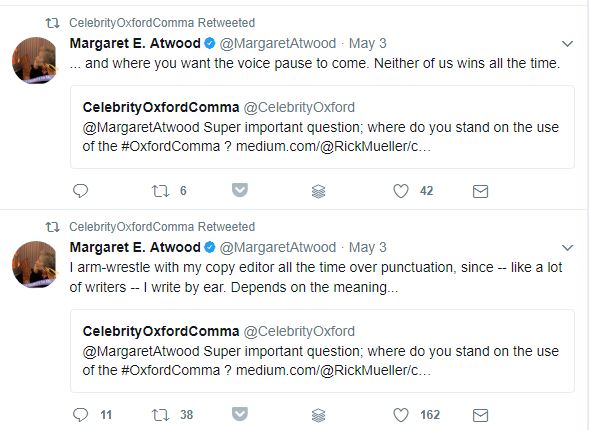
Should using the Oxford comma (also known as the “serial comma”) be a requirement? This is one of the most heated debates in the realm of grammar today. This debate exists not just among writers, but large institutions too. There's even a Twitter account dedicated to asking celebrities about their choice to use (or not use) the Oxford Comma, @CelebrityOxford. Margaret Atwood, the noted author and literary critic, recently disclosed her thoughts on the topic there.
Topics: Oxford comma, Comma
5 Tips to Beat Writer's Block
Posted by Kelly Creighton Jun 29, 2017, 7:30:00 AM
There you are, staring at a blank screen with a blinking cursor that’s mocking you. You have absolutely no ideas and a deadline that’s looming. You feel as if you’ve forgotten the entire alphabet overnight and couldn’t even write your name if the fate of the world depended on it. Panic starts to set in, and you finally realize that you’re experiencing writer’s block.
Topics: business writing, creative writing, fighting writer's block, beat writer's block
Common Writing Mistakes and How to Avoid Them – Part 2
Posted by Kelly Creighton Jun 1, 2017, 7:30:00 AM
Last week’s post was only the beginning of an even longer list of common mistakes writers are prone to make. Below are a few more common mistakes you should remember the next time you’re writing something, so you can fix them before you share or publish your final draft.
Topics: common mistakes, writing mistakes
Search Our Blog
Recent Posts
Posts by Topic
- business writing (33)
- punctuation (30)
- misused words (24)
- proofreading (24)
- grammar (20)
- vocabulary test (20)
- capitalization (16)
- quiz (15)
- hyphenation (13)
- pronouns (13)
- writing tips (13)
- vocabulary quiz (12)
- adjectives (10)
- word quiz (10)
- adverbs (9)
- common mistakes (9)
- possessives (9)
- verbs (9)
- word test (9)
- Video (8)
- conjunctions (8)
- grammar errors (8)
- legal writing (8)
- numbers (8)
- writing (8)
- Chicago Manual of Style (7)
- effective writing (7)
- grammar quiz (7)
- prepositions (7)
- quotation marks (7)
- typos, typographic errors (7)
- vocabulary (7)
- GrammarTip video (6)
- Popular Style Guides (6)
- Style Guides (6)
- artificial intelligence (6)
- hyphen (6)
- marketing writing (6)
- quiz answers (6)
- word usage (6)
- Comma (5)
- Oxford comma (5)
- abbreviations (5)
- business communications (5)
- commas (5)
- email marketing (5)
- idioms (5)
- passive voice (5)
- question mark (5)
- AI (4)
- clarity proofreading (4)
- consistency in writing (4)
- editing (4)
- errors (4)
- homonyms (4)
- infinitives (4)
- plural or singular verb (4)
- preposition (4)
- proofreaders (4)
- proofreading tips (4)
- proofreadinq quiz (4)
- slang (4)
- subjunctive form (4)
- website copy (4)
- word meaning (4)
- writing style (4)
- writing techniques (4)
- active voice (3)
- apostrophe (3)
- cliches (3)
- common proofreading mistakes (3)
- contest (3)
- creative writing (3)
- dictionary (3)
- email (3)
- grammar rules (3)
- grammatical errors (3)
- medical writing (3)
- periods (3)
- plural (3)
- professional proofreading (3)
- proofreader (3)
- proofreading for legal documents (3)
- proofreading quality (3)
- proofreading quiz (3)
- proofreading websites (3)
- spacing (3)
- spelling (3)
- style copyediting (3)
- style guide (3)
- technical writing (3)
- trends in language (3)
- typographical errors (3)
- typos (3)
- what to expect from proofreaders (3)
- who (3)
- word choices (3)
- writing about boring topics (3)
- writing mistakes (3)
- writing numbers (3)
- 10 helpful tips (2)
- AP style (2)
- Associated Press Stylebook (2)
- English language (2)
- I or me (2)
- Latin abbreviations (2)
- Modern Language Association Style Manual (2)
- Nouns (2)
- Oxford Style Manual (2)
- The Elements of Style (2)
- alot/a lot (2)
- apostrophes (2)
- automated grammar checker (2)
- b2b marketing content (2)
- b2b writing help (2)
- business proofreading (2)
- clauses (2)
- collective noun (2)
- copyright (2)
- correct pronunciation (2)
- correcting grammar (2)
- dangling modifiers (2)
- dates (2)
- em dash (2)
- financial writing (2)
- formal writing (2)
- gerunds (2)
- grammar checker (2)
- grammar checker software (2)
- grammar mistakes (2)
- grammar tips (2)
- how are words added to the dictionary (2)
- how to write out money in text (2)
- informal writing (2)
- italicize (2)
- jargon (2)
- lay (2)
- laying (2)
- legal proofreading (2)
- lie (2)
- maintain consistency in writing (2)
- malapropism (2)
- misspelled words (2)
- misspellings (2)
- nonrestrictive clauses (2)
- parallel structure (2)
- parallelism (2)
- parts of speech (2)
- percent (2)
- percent sign (2)
- percentage (2)
- percentage points (2)
- persuade (2)
- plurals (2)
- possessive form (2)
- possessives of proper nouns (2)
- prefixes (2)
- pronunciation (2)
- proofread (2)
- proofreading for business (2)
- proofreading quiz answers (2)
- proofreading tricks (2)
- proposals (2)
- public relations writing (2)
- public speaking (2)
- punctuation quiz (2)
- quotations (2)
- redundancy (2)
- restrictive clauses (2)
- sentence structure (2)
- split infinitive (2)
- suffixes (2)
- synonyms (2)
- that (2)
- their (2)
- there (2)
- they're (2)
- typographic errors (2)
- using I or me (2)
- using jargon (2)
- what to expect from a proofreader (2)
- which (2)
- whom (2)
- writers (2)
- writing for your audience (2)
- writing guidelines (2)
- writing quiz (2)
- writing voice (2)
- #writersblock (1)
- AM (1)
- AMA (1)
- AP stylebook (1)
- APA (1)
- B2B Writing (1)
- Find and replace (1)
- Greek word roots (1)
- Gregg Reference Manual (1)
- Latin word roots (1)
- Midnight (1)
- Noon (1)
- O or oh (1)
- PM (1)
- academic terms (1)
- affixes (1)
- ahold/a hold (1)
- alright/all right (1)
- antecedents (1)
- antonym (1)
- appositives (1)
- articles (1)
- avoiding gender bias (1)
- awhile/a while (1)
- beat writer's block (1)
- beside or besides? (1)
- bias (1)
- bibliography (1)
- bizspeak (1)
- bloated writing (1)
- blog (1)
- blog posts (1)
- business phrases to stop using (1)
- buzzwords (1)
- casual writing (1)
- comparatives (1)
- comparison of proofreading services (1)
- complementary infinitives (1)
- complements (1)
- compound modifiers (1)
- compound nouns (1)
- compound sentences (1)
- compound verbs (1)
- compound words (1)
- conditional clauses (1)
- confusing words (1)
- conjugating verbs (1)
- consistency in proofreading (1)
- consistent messaging (1)
- content (1)
- continuously and continually (1)
- convince (1)
- copyediting (1)
- copyeditor (1)
- cursive writing (1)
- dash (1)
- documents (1)
- double negative (1)
- double negatives (1)
- dumbing down of language (1)
- e.g. (1)
- each other and one another (1)
- editorial occupations (1)
- eggcorns (1)
- either (1)
- either as a pronoun (1)
- emoji (1)
- emojis (1)
- en dash (1)
- essential clauses (1)
- exclamation point (1)
- exempli gratia (1)
- false subject (1)
- farther (1)
- fighting writer's block (1)
- figures (1)
- first-person pronouns (1)
- footnotes (1)
- foreign phrases (1)
- foreign words (1)
- functional shift (1)
- further (1)
- gender bias (1)
- government writing (1)
- government-related words (1)
- grammar fails (1)
- headline errors (1)
- holidays (1)
- homographs (1)
- homophone (1)
- hypallage (1)
- hyperbole (1)
- i.e., (1)
- id est (1)
- if and whether (1)
- imperative mood (1)
- imply (1)
- in behalf of and on behalf of (1)
- independent clauses (1)
- indicative mood (1)
- infer (1)
- infinitive (1)
- interrogative pronouns (1)
- into versus in to (1)
- irregardless (1)
- irregular verbs (1)
- it is (1)
- it's (1)
- its (1)
- laid (1)
- lain (1)
- liable and likely (1)
- like (1)
- links (1)
- literally (1)
- literary devices (1)
- lying (1)
- main clauses (1)
- marketing email (1)
- misplaced modifiers (1)
- missing dates (1)
- mistakes (1)
- modifiers (1)
- multiple subjects (1)
- myth (1)
- negatives (1)
- neither (1)
- neither as a pronoun (1)
- noun clauses (1)
- objective pronouns (1)
- onomatopoeia (1)
- onto versus on to (1)
- or that (1)
- paragraph (1)
- paragraph construction (1)
- participle (1)
- participles (1)
- past participle (1)
- past tense (1)
- personal profile (1)
- placement of only (1)
- plural pronouns (1)
- pluralize (1)
- points (1)
- preposition at end of sentence (1)
- prepositional phrases (1)
- present participle (1)
- present perfect tense (1)
- presently (1)
- press release length (1)
- press releases (1)
- professional proofreader (1)
- project management (1)
- pronoun (1)
- pronouncing words beginning with h (1)
- pronouns with than (1)
- proofeading technique (1)
- proofreader myths (1)
- proofreading errors (1)
- proofreading mistakes (1)
- proofreading red flags (1)
- published documents (1)
- readability (1)
- redundant phrases (1)
- reflexive pronouns (1)
- regular verbs (1)
- relative clauses (1)
- relative pronouns (1)
- religious words (1)
- repeating words (1)
- resume (1)
- resume writing (1)
- rules for writing (1)
- run-on sentences (1)
- scientific terms (1)
- scientific writing (1)
- search engines (1)
- semicolon (1)
- sentence fragments (1)
- sentence restructure (1)
- sentences (1)
- seo (1)
- sic (1)
- singular (1)
- singular pronouns (1)
- singular they (1)
- singular verb (1)
- skills needed for proofreading (1)
- skills-based resume (1)
- slang expressions (1)
- slash (1)
- social media (1)
- space issues (1)
- spaces (1)
- speech writing (1)
- spell check (1)
- spell-check software (1)
- squinting modifiers (1)
- starting sentences with and (1)
- style sheet (1)
- subject complements (1)
- subjective pronouns (1)
- subjunctive mood (1)
- superscript (1)
- supposably (1)
- survey (1)
- technical editing (1)
- templats (1)
- thank you notes (1)
- that is (1)
- that vs. which (1)
- that's (1)
- this versus that (1)
- time (1)
- time of day (1)
- time-related modifiers (1)
- toward or towards (1)
- two letter word (1)
- under way (1)
- underway (1)
- use of because (1)
- using a colon (1)
- using spaces in abbreviations (1)
- verbosity (1)
- video content (1)
- was (1)
- were (1)
- were or was (1)
- what proofreaders don't do (1)
- what proofreaders want you to know (1)
- what to expect from a copyeditor (1)
- what to expect from an editor (1)
- when to omit that (1)
- when to use that (1)
- whereas (1)
- which word is correct (1)
- who and whoever (1)
- whom and whomever (1)
- word roots (1)
- words (1)
- words to avoid (1)
- writing bios (1)
- writing currency (1)
- writing dates (1)
- writing marketing copy (1)
- writing myth (1)
- writing number in dialogue (1)
- writing portfolio (1)
- writing press releases (1)
- writing rituals (1)
- writing skills (1)
- writing thank you notes (1)
- writing topics (1)
- writing web copy (1)
- you or yourself (1)